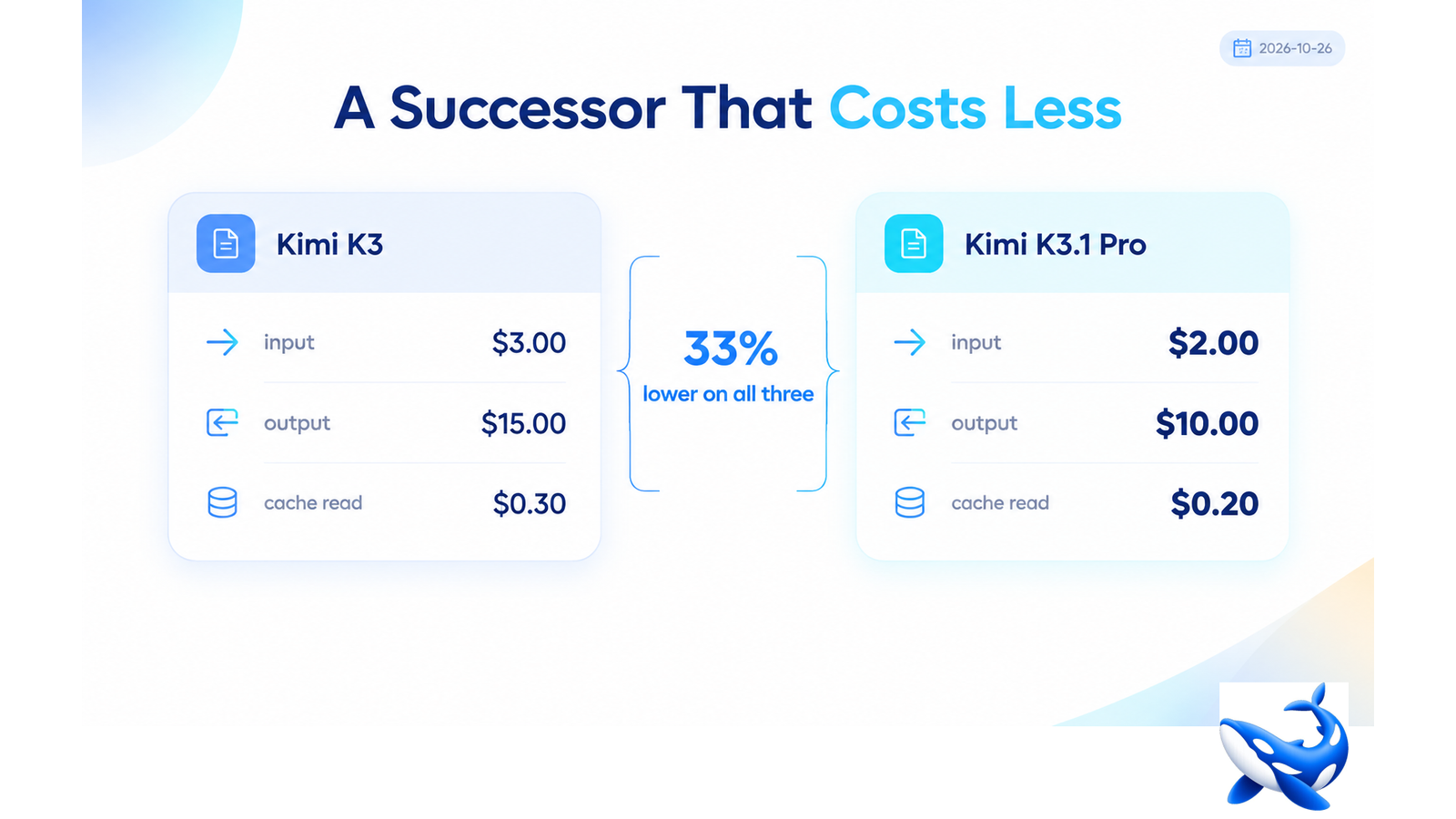

A successor model that costs less than the model it replaces is rare enough that it should lead every story about Kimi K3.1 Pro, and on a draft-day rate card it does. Moonshot cut all three billed lines by a third: $2.00 per million input tokens, $10.00 per million output, $0.20 per million cached reads, against $3.00, $15.00 and $0.30 for the Kimi K3 it was post-trained from [VENDOR]. Those three numbers are exactly what OrcaRouter publishes for Kimi K3.1 Pro pricing — passed through at list, with no markup added — which makes the arithmetic in this article reproducible rather than reported: a request that reads a million tokens and writes two hundred thousand costs $6.00 on Kimi K3 and $4.00 on Kimi K3.1 Pro.
That is the whole case for switching, and it is a good one. It is also incomplete, because the rate card is not the bill, and two of the three lines that moved are invisible in most coverage. What follows is the rate card line by line, the two lines that usually get dropped, and the reason a third cheaper per token has not produced a third cheaper workload.
The rate card, including the part usually omitted
| Line (per 1M tokens) | Kimi K3 | Kimi K3.1 Pro | Change |
| Input | $3.00 | $2.00 | −33% |
| Output | $15.00 | $10.00 | −33% |
| Cache read | $0.30 | $0.20 | −33% |
| Cache write, 5-minute TTL | $3.00 | $2.00 | −33% |
| Cache write, 1-hour TTL | $6.00 | $4.00 | −33% |
| Blended 3:1 input:output | $6.00 | $4.00 | −33% |
Five lines, one ratio. The two that get left out of summaries are the cache-write lines, and they matter more than their position in the table suggests. Caching on the Kimi platform is automatic for repeated request prefixes, with a five-minute TTL by default [VENDOR]. An agent that re-reads a repository or a long document on every turn is not buying input at $2.00; it is buying a first write at $2.00 or $4.00 and then reads at $0.20. The cache write is the expensive half of that pattern, and it fell by the same third as everything else.
There is also a second SKU the rate card does not show: Moonshot lists a Highspeed variant at $4.00 input and $20.00 output, the same model served two to three times faster with roughly twice the quota consumption in Kimi Code [VENDOR]. Our own catalogue carries the standard model only. If you have seen a $4/$20 number attached to this launch and it confused you, that is where it comes from — it is a different SKU, not a different currency.

What a third off does to a real request
Take the shape of request that this model is actually bought for: a large context, read many times, answered once. A 1M-token prompt with a 200K-token answer is $6.00 on Kimi K3 and $4.00 on Kimi K3.1 Pro. Do it ten times a day for a month and the difference is $600.
Now add the caching that the platform applies automatically. If nine tenths of that prompt is a stable prefix that stays inside the five-minute TTL, the second and later calls in a burst read at $0.20 per million instead of $2.00 — a 90% discount — and the same 90% applies to the write path. The cut is multiplicative with caching rather than additive, which is why teams that already cache see more than a third off in practice, and teams that send a fresh prompt every time see exactly a third.
The interesting number is what this does to the *break-even against a bigger model*. At $2.00 and $10.00, Kimi K3.1 Pro’s blended 3:1 price is $4.00 per million. Claude Opus 5.5 blends to $8.00 at $4.00 and $20.00, and both GPT-6 Astra and Claude Fable 5.1 blend to $20.00 at $10.00 and $50.00 [INDEPENDENT — Artificial Analysis rate cards, 26 October]. Whatever you conclude about capability — and the honest answer is that the three models are within a few points of each other on the independent index — the price axis is not close.
The catch: the output line moved, but the output volume did not
Here is where the “33% cheaper” story needs a second sentence. Kimi K3.1 Pro always thinks. Thinking cannot be turned off, and `reasoning_effort` accepts `low`, `high` or `max`, defaulting to max [VENDOR]. A default at maximum effort means a default at maximum output tokens, and output is the line with the $10.00 price on it.
Artificial Analysis measures the consequence directly. Its canonical run over 1,474 Intelligence Index tasks produced 55,195 output tokens per task, of which 34,883 were reasoning tokens and 20,312 were answer tokens [INDEPENDENT]. The same evaluator puts Kimi K3 at about 48,000 output tokens per task, so the newer model emits roughly 14% more [INDEPENDENT]. The rate fell by a third; the volume rose by a seventh; the two partly cancel.
The evaluator’s own cost figure is the one to plan against, and it is not a third lower. Artificial Analysis puts Kimi K3.1 Pro at $2.11 per Intelligence Index task [INDEPENDENT, 26 October]. Its launch note described the figure as about $1.98, roughly equal to Kimi K3’s cost per task. Either way, the per-token cut did not become a per-task cut. You are buying a cheaper token and buying more of them.
Where the bill actually lands
The per-task decomposition is worth reading closely, because it inverts the usual intuition about which line to negotiate:
| Component of one index task | Cost |
| Cached input reads | $1.0565 |
| Output (reasoning + answer) | $0.5519 |
| Cache writes | $0.4622 |
| Non-cached input | $0.0438 |
| Total | $2.1145 |
Cached reads are half the bill. Non-cached input is two percent. The headline $10 output price accounts for a quarter. If you take one number from this article, take the $0.20 cache-read line rather than the $10 output line: on a long-context, repeated-prefix workload — the workload this model is priced for — the cache read is the meter that runs.
That also means the 33% cut is best understood as a cut to the *dominant* line, not a marketing gesture on the cheap one. A 33% reduction on the line that carries half the cost is worth more than the same percentage on a line carrying two percent, and Moonshot applied it uniformly.

Should the cut decide it
For a workload that is already on Kimi K3 and mostly reads: yes, move, and expect something close to a third. The full cache discount applies to a larger share of tokens at a lower unit price, and the model is a one-string change rather than a migration.
For a workload where output dominates — generation, long answers, agentic loops that write more than they read — model the verbosity first. The default effort is `max`, and there is no setting that returns you to a non-thinking mode, so the way to control output volume is `low` effort and a hard `max_completion_tokens`, not a cheaper rate.
For a workload where a fraction of a point decides the outcome, price is not the tie-breaker. The independent index puts Kimi K3.1 Pro 2.5 points behind Claude Opus 5.5 and 2.4 points ahead of GPT-6 Astra [INDEPENDENT], so the cut buys you a fifth-to-a-half of the frontier’s price for a capability difference measured in single points, in either direction.
The summary is unglamorous and useful: the rate card is genuinely a third cheaper, on all five lines, and the workload bill is roughly where it was per task because the model writes more. Both statements are true at once, and the second one only appears if you ask what a task costs rather than what a token costs.
Sourcing note: rate card, cache-write lines, Highspeed SKU and the effort defaults are Moonshot’s own published figures, checked on the vendor’s pricing and quickstart pages on 26 October 2026. Per-task cost, output-token volume and the decomposition are Artificial Analysis measurements on index v4.3.2, read the same day. The pass-through price and the availability of the standard SKU (and only the standard SKU) on our route are OrcaRouter’s own catalogue. The 33% figure is Moonshot’s; the arithmetic on 1M-in/200K-out is ours and is reproducible from the card.